Jesus told his disciples this parable:
"A man going on a journey called in his servants and entrusted his possessions to them. To one he gave five talents; to another, two; to a third, one--to each according to his ability. Then he went away.
Immediately the one who received five talents went and traded with them,and made another five. Likewise, the one who received two made another two. But the man who received one went off and dug a hole in the ground and buried his master's money.
After a long time the master of those servants came back and settled accounts with them. The one who had received five talents came forward bringing the additional five. He said, 'Master, you gave me five talents. See, I have made five more.’ His master said to him, 'Well done, my good and faithful servant. Since you were faithful in small matters, I will give you great responsibilities. Come, share your master's joy.’ Then the one who had received two talents also came forward and said,'Master, you gave me two talents. See, I have made two more.' His master said to him, 'Well done, my good and faithful servant. Since you were faithful in small matters, I will give you great responsibilities. Come, share your master's joy.’ Then the one who had received the one talent came forward and said, 'Master, I knew you were a demanding person, harvesting where you did not plant and gathering where you did not scatter; so out of fear I went off and buried your talent in the ground. Here it is back.' His master said to him in reply, 'You wicked, lazy servant! So you knew that I harvest where I did not plant and gather where I did not scatter? Should you not then have put my money in the bank so that I could have got it back with interest on my return? Now then! Take the talent from him and give it to the one with ten. For to everyone who has, more will be given and he will grow rich; but from the one who has not, even what he has will be taken away. And throw this useless servant into the darkness outside, where there will be wailing and grinding of teeth.'"
Matthew 25:14-30
Sunday, November 16, 2008
The Parable of the Talents


Friday, November 14, 2008
Catholic Bishops post Obama election
Cardinal Francis George: “The common good can never be adequately incarnated in any society when those waiting to be born can be legally killed at choice,”
Bishop Joseph Martino of Scranton singled out Vice President-elect Biden, a Catholic, Scranton native who supports abortion rights: “I cannot have a vice president-elect coming to Scranton to say he’s learned his values there when those values are utterly against the teachings of the Catholic Church,”
Archbishop Joseph Naumann of the Diocese of Kansas City in Kansas said politicians “can’t check your principles at the door of the legislature.” Naumann has said repeatedly that Kansas Gov. Kathleen Sebelius, a Catholic Democrat who supports abortion rights, should stop taking Holy Communion until she changes her stance. “They cannot call themselves Catholic when they violate such a core belief as the dignity of the unborn,” Naumann said Tuesday.
Auxiliary Bishop Thomas Paprocki of Chicago said the hospitals would close rather than comply.
“We have a very important thing to say. I think we should say it clearly and with a punch,” said New York Cardinal Edward Egan.
Bishop Joseph Martino of Scranton singled out Vice President-elect Biden, a Catholic, Scranton native who supports abortion rights: “I cannot have a vice president-elect coming to Scranton to say he’s learned his values there when those values are utterly against the teachings of the Catholic Church,”
Archbishop Joseph Naumann of the Diocese of Kansas City in Kansas said politicians “can’t check your principles at the door of the legislature.” Naumann has said repeatedly that Kansas Gov. Kathleen Sebelius, a Catholic Democrat who supports abortion rights, should stop taking Holy Communion until she changes her stance. “They cannot call themselves Catholic when they violate such a core belief as the dignity of the unborn,” Naumann said Tuesday.
Auxiliary Bishop Thomas Paprocki of Chicago said the hospitals would close rather than comply.
“We have a very important thing to say. I think we should say it clearly and with a punch,” said New York Cardinal Edward Egan.
Tuesday, October 21, 2008
Bishop Serratelli of Paterson Diocese rebuke Obama
Bishop Serratelli: No Right to Life! No Freedom!
With 108 members of Congress, Obama support Freedom of Choice Act. He promised Planned Parenthood the first thing he would sign as President is the Freedom of Choice Act.
With 108 members of Congress, Obama support Freedom of Choice Act. He promised Planned Parenthood the first thing he would sign as President is the Freedom of Choice Act.
Every vote counts. Today, either we choose to respect and protect life, especially the life of the child in the womb of the mother or we sanction the loss of our most basic freedoms.
Sunday, October 05, 2008
Bishop rebukes Biden again!
Today is Respect Life Sunday.
Bishop Martino of Scranton on Respect Life Sunday 10/4/2008
Catholic Online (www.catholic.org)
Bishop Martino of Scranton on Respect Life Sunday 10/4/2008
Catholic Online (www.catholic.org)
A person who supports permissive abortion laws rejects the truth that innocent human life may never be destroyed. This profound moral failure runs deeper than any error in applying just war criteria to particular cases.
Thursday, October 02, 2008
Catholic 'Doctors of the Church'...
I never know who the 'Doctors of the Church' are frequently mentioned by converts interviewed by Marcus Grodi in The Journey Home, EWTN, Monday 8pm EST until now.
I've read St. Augustine major work 'City of God, Confession and Letters', St. Thomas' 5 volume Summa Theologica and St Therese of Lisieux 'Story of a Soul'.
via Catholic Online.com.
Doctors of the Church
This is a very special title accorded by the Church to certain saints. This title indicates that the writings and preachings of such a person are useful to Christians "in any age of the Church." Such men and women are also particularly known for the depth of understanding and the orthodoxy of their theological teachings. While the writings of the Doctors are often considered inspired by the Holy Spirit. This does not mean they are infallible, but it does mean that they contributed significantly to the formulation of Christian teaching in at least one area.
I've read St. Augustine major work 'City of God, Confession and Letters', St. Thomas' 5 volume Summa Theologica and St Therese of Lisieux 'Story of a Soul'.
via Catholic Online.com.
Saturday, September 27, 2008
Tuesday, September 23, 2008
Congress, no FOCA please...
Cardinal Rigali, Archbishop of Philadelphia, Chairman, Committee on Pro-Life Activities, United States Conference of Catholic Bishops letter to Members of Congress on September 19, 2008 here.
It's all about control and strengthening of Roe v. Wade.
tip: marketwatch.com, headlinebistro.com
gravely concerned about any possible consideration of the "Freedom of Choice Act" ("FOCA," S.1173 and H.R.1964). FOCA would deprive the American people in all 50 states of the freedom they now have to enact modest restraints and regulations on the abortion industry.
It's all about control and strengthening of Roe v. Wade.
tip: marketwatch.com, headlinebistro.com
Monday, September 22, 2008
The Womb
Fr. Thomas J. Loya writes about 'The Womb' in The Theology of the Body.
We have spoken before in this column about the "genius of womanhood" which is stamped in the very language of the female body. This genius of womanhood holds the key to the most powerful force in the created order — femininity. The power of femininity lies in the one thing that distinguishes womanhood itself — the womb.
Saturday, September 20, 2008
K of C head admonish Biden
Wednesday, September 10, 2008
Election Novena from Priests For Life...
O God, we acknowledge you today as Lord,
Not only of individuals, but of nations and governments.
We thank you for the privilege
Of being able to organize ourselves politically
And of knowing that political loyalty
Does not have to mean disloyalty to you.
We thank you for your law,
Which our Founding Fathers acknowledged
And recognized as higher than any human law.
We thank you for the opportunity that this election year puts before us,
To exercise our solemn duty not only to vote,
But to influence countless others to vote,
And to vote correctly.
Lord, we pray that your people may be awakened.
Let them realize that while politics is not their salvation,
Their response to you requires that they be politically active.
Awaken your people to know that they are not called to be a sect fleeing the world
But rather a community of faith renewing the world.
Awaken them that the same hands lifted up to you in prayer
Are the hands that pull the lever in the voting booth;
That the same eyes that read your Word
Are the eyes that read the names on the ballot,
And that they do not cease to be Christians
When they enter the voting booth.
Awaken your people to a commitment to justice
To the sanctity of marriage and the family,
To the dignity of each individual human life,
And to the truth that human rights begin when human lives begin,
And not one moment later.
Lord, we rejoice today
That we are citizens of your kingdom.
May that make us all the more committed
To being faithful citizens on earth.
We ask this through Jesus Christ our Lord. Amen.
Tuesday, September 09, 2008
Senator Biden admonished by Archbishop Chaput!
Public Servants and Moral Reasoning (pdf)
via Hotair.com, Ed Morrissey
"Abortion is a foundational issue; it is not an issue like housing policy or the price of foreign oil. It always involves the intentional killing of an innocent life, and it is always, grievously wrong."
via Hotair.com, Ed Morrissey
Sunday, September 07, 2008
Answered Prayers!
Blessed Mother, thank you for Sarah Palin!
from Townhall.com, Lee Culpepper
Palin is an answered prayer. She is exactly what America and John McCain needed. She is a proven leader. And leaders have an obligation to inspire others to do what is in the nation’s best interest.
from Townhall.com, Lee Culpepper
Friday, September 05, 2008
Amazing Grace - Sarah Palin
from humanevents.com, Peter Sprigg...
three profound misunderstandings of how social conservatives in general, and evangelical Christians in particular, think.
The first of these has to do with “moral values.” Yes, we believe that having sex before marriage is morally wrong (and dangerous -- conservative values are pragmatic, not just moralistic). So Bristol’s choice to engage in that behavior was wrong as well.
But while having sex outside of marriage is bad, deliberately destroying an innocent human life through abortion (no matter how that child was conceived) is far, far worse. That is why conservative celebration of Bristol’s decision to carry her child to term -- under circumstances where many would choose abortion -- outweighed disappointment over her sexual behavior. (Her announced intention to marry the father is also a plus, despite the unfortunate circumstances.)
This situation only underscores the sincerity of the Palin family’s pro-life convictions. Earlier this year, Gov. Palin gave birth to her son Trig -- despite knowing that he had Down syndrome, a diagnosis that leads to abortion in eighty percent of the time. Now, the Palins have again chosen life. When pro-abortion zealots say, “You don’t understand the agonizing personal circumstances that lead to abortion,” Sarah Palin can answer, “Yes, I do -- but I chose life.”
The second misunderstanding is about the role of women. The liberal stereotype of social conservatives, especially evangelicals, is that we think women should be perpetually barefoot and pregnant in the kitchen, rather than pursuing careers and assuming leadership roles in the political realm. So shouldn’t a mother of five (including a pregnant teen and a special-needs infant) be a homemaker, instead of trying to govern Alaska or run for vice president?
Well, yes -- if she chooses to. Many intelligent, well-educated, accomplished women do choose to stay home with their children -- and they should not be accused of “wasting” their talents or their education, as they often are by liberal feminists.
But those women who feel that they are able to balance career and family, with the help of a supportive husband, have every right to do so. Some of the most distinguished leaders in the social conservative movement, such as Beverly LaHaye, Phyllis Schlafly, Charmaine Yoest, and Connie Mackey, are women and mothers.
The final misunderstanding is theological. Contrary to stereotype, Christianity is not a religion of condemnation, but of grace. The good news, the gospel, the “evangel” (from which the word “evangelical” comes) is that even though every one of us is a sinner, every one of us can also be forgiven our sins, because Christ took the punishment for them on the cross. “Grace” is God’s unmerited favor -- the love he pours out on his children, not because we deserve it, but despite the fact that we don’t.
Wednesday, September 03, 2008
Blessed Mother, thank you for Sarah Palin!
Mary, Refuge of Holy Love
Thank you for answering our prayers!
We still pray for most voters (on the left and Democrat party) on November 4, 2008 will see the light most Republicans have seen since Governor Sarah Palin's speech on August 29,2008.
Thank you for answering our prayers!
We still pray for most voters (on the left and Democrat party) on November 4, 2008 will see the light most Republicans have seen since Governor Sarah Palin's speech on August 29,2008.
Monday, September 01, 2008
God Bless Gov. Sarah Palin's family
They have demonstrated clearly what it takes to be Pro-Life.
Lord, give them strength!
via Foxnews.com
Lord, give them strength!
“Our beautiful daughter Bristol came to us with news that as parents we knew would make her grow up faster than we had ever planned. We’re proud of Bristol’s decision to have her baby and even prouder to become grandparents. As Bristol faces the responsibilities of adulthood, she knows she has our unconditional love and support.”
via Foxnews.com
Wednesday, August 27, 2008
Archbishop Chaput respond to Speaker Pelosi's false Catholic belief
Catholic public leaders inconvenienced by the abortion debate tend to take a hard line in talking about the "separation of Church and state." But their idea of separation often seems to work one way. In fact, some officials also seem comfortable in the role of theologian. And that warrants some interest,not as a "political" issue, but as a matter of accuracy and justice.
Speaker of the House Nancy Pelosi is a gifted public servant of strong convictions and many professional skills. Regrettably, knowledge of Catholic history and teaching does not seem to be one of them.
Most Rev. Charles J. Chaput, O.F.M. Cap., Archbishop of Denver, CO. 8/25/08
Monday, August 25, 2008
Sunday, August 24, 2008
Novena to Mary, Refuge of Holy Love for '08 election!
Four Month Novena to Mary, Refuge of Holy Love
Mary, Refuge of Holy Love, intercede for our country with your Immaculately-Conceived Heart during the upcoming elections. Since you are the Ever-Virgin Mary and Mother of the true God, obtain for us from the Blessed Trinity a president and other elected political leaders who will help the United States become a country of great purity and high morality.O Sweet Blessed Mother, intercede for us that our next president will support life for each individual at every stage, uphold family life, and influence other countries throughout the world to love God above all else and neighbor as self, to serve Him, and to live for Him alone. Time and again you have given us your gracious assistance, and thus we humbly and gratefully acknowledge you as our Patron.
Mary, conceived without sin, pray for us who have recourse to thee and all those who do not have recourse to thee!
May Eternal Father shine His Light upon our country and the whole world. Amen
Saturday, August 23, 2008

Sunday, August 17, 2008

Saturday, May 31, 2008
God's place in wars!
http://www.breakpoint.org/listingarticle.asp?ID=7965
'war is crucifixion: God’s place in war is on the cross'
Sunday, September 30, 2007
Pilgrimage of Cardinal Sean in Istanbul
Must see and read Cardinal Sean's blog this week. Lots of pictures of ancient church turn museum in Istanbul and St Petersburg with corresponding commentary. Better than if I've gone on pilgrimage myself.
The Muslims have a devotion to the Blessed Mother. They have adopted a lot of things from the New Testament, and one of them is regard for Christ, even though they do not accept his divinity, and also a very tender devotion to Mary.I pray for our Blessed Mother's intercession to enlighten radical, fanatical and terror prone Muslims on ways to assimilate themselves and tolerate other people with or without faith.
Sunday, September 23, 2007
Cardinal Sean of Boston
Check his blog every Friday. This week is full of pictures of his group's pilgrimage, this time in Rome.
I am currently leading, together with Metropolitan Methodios of the Greek Orthodox Metropolis of Boston, a joint pilgrimage to Rome, Constantinople and Saint Petersburg. My blog gives me the opportunity to share the pilgrimage with Catholics from Boston and beyond who were unable to accompany us.Thank you, Cardinal Sean for blogging...
Saturday, September 22, 2007
Filipino Catholic Charismative movement
For years, it puzzle me why Catholic Charismatic movement is popular in the Philippines. I credit such movement for keeping Filipinos catholic inspite of other Christian denominations openly evangelizing all over the islands.
My sister has her own organize charismatic ministry and community.
They pray and evangelize like Protestants in America but more like the Pentecostal and Baptist denomination with all the seven sacraments of the Catholic church. A lot of singing, praising, witnessing as well as tithing.
My sister has her own organize charismatic ministry and community.
They pray and evangelize like Protestants in America but more like the Pentecostal and Baptist denomination with all the seven sacraments of the Catholic church. A lot of singing, praising, witnessing as well as tithing.
Saturday, September 08, 2007
Proverbs, 1:7
'The fear of the LORD is the beginning of knowledge; wisdom and instruction fools despise'.
Sunday, September 02, 2007
Why Democrats do what they do...
From my favorite bloggers old post - Powerlineblog...
This is truly an intelligent assessment of why most Democrats do what they do. I say, most them have no 'fear of the Lord' (Proverbs, 1:7).
This is truly an intelligent assessment of why most Democrats do what they do. I say, most them have no 'fear of the Lord' (Proverbs, 1:7).
But why should this new form of cynicism appear just now, and why primarily among Democrats? I believe the answer to the first question lies in the modern (or actually the post-modern) intellectual climate. The essentially frivolous manner in which Clinton and Gore approach vital issues has clear parallels in current intellectual and academic thought. In the post-modern intellectual climate, “texts” (e.g., great literature, philosophy, and even laws and judicial opinions) are not valued in their own right, but rather exist to be appropriated by creative “scholars” for whatever purposes they see fit. Everything is up for grabs. The only limit on valid interpretation is the imagination, and political correctness quotient, of the
interpreter. In this world, it becomes possible for politicians to ask what “the meaning of ‘is’ is.” And once that point is reached, it becomes possible to suggest that whether one should vote to go to war does not necessarily depend on who has the better arguments.Why has this tendency surfaced largely among Democrats? One plausible answer is that Democrats are more closely linked than Republicans with academia, the true home of post-modernism. However, while Clinton and Gore undoubtedly have “breathed the air” of post-modernism, so too have many Republican politicians–it is all around us.
A better explanation is that necessity is the mother of invention. After 1964 and before 1992, the Democrats lost five of six presidential elections, including three landslides. Their positions had become so unpopular that the term “liberal” became an epithet of derision. The party’s options were to change its core beliefs or to disguise them. Opting largely for the latter alternative, it needed and found leaders who were particularly skillful in the art of deception.
But this deception could only be tried if the Democrats were confident of getting away with it. And only the Democrats could have that confidence. First, only
Democrats could be confident that the overwhelmingly liberal media would, by-and-large, give them a pass. More fundamentally, only Democrats could be confident that their core constituencies would do so too.
The Democratic Party contains at least two core constituencies – African-Americans and feminists – whose leaders view rules as instruments of their oppression and
barriers to their advancement. In fact, the centerpiece of much modern civil rights employment litigation is the attack on neutral rules that disproportionately exclude African Americans from a particular job. Examples include tests, educational requirements, and even the requirement that an employee not have been convicted of a crime. Similarly, what is the demand for affirmative action other than a demand that the normal rules for selecting employees based on merit be ignored to the extent that they interfere with desired outcomes? And the disregard of leading feminists for the basic rules of scholarship is apparent in the notoriously shoddy “feminist scholarship” that has been exposed by Christina Hoff Sommers and others.
The common thread here is something akin to cheating. No wonder these core groups, and the sophisticates who believe that rules exist only to be deconstructed, admired Clinton’s intellectual gyrations on key issues and now tolerate Gore’s less supple efforts.
Hebrew 12:5-13
You have also forgotten the exhortation addressed to you as sons: "My son, do not disdain the discipline of the Lord or lose heart when reproved by him; for whom the Lord loves, he disciplines; he scourges every son he acknowledges."Lora, in hope and prayer to ease your aching heart with all my love,
Endure your trials as "discipline"; God treats you as sons. For what "son" is there whom his father does not discipline? If you are without discipline, in which all have shared, you are not sons but bastards. Besides this, we have had our earthly fathers to discipline us, and we respected them. Should we not (then) submit all the more to the Father of spirits and live? They disciplined us for a short time as seemed right to them, but he does so for our benefit, in order that we may share his holiness. At the time, all discipline seems a cause not for joy but for pain, yet later it brings the peaceful fruit of righteousness to those who are trained by it. So strengthen your drooping hands and your weak knees. Make straight paths for your feet, that what is lame may not be dislocated but healed.
Saturday, September 01, 2007
Praying for conversion of Christopher Hitchens
Lord God, only you understand man's neural circuit and cardiac flutter, today I pray at your feet for the soul of Christopher Hitchens. Open a screen to his thoughts of your presence and power. Amen.
Saturday, July 28, 2007
Fr. Donald Calloway
frequent viewer of Marcus Grodi's Journey Home program, Monday, 8pm on EWTN. Last week's guest was Fr. Donald Calloway. What a miraculous conversion at such a young age! Twice on the show he mentioned Filipino women. A Filipino woman introduced his mother to Catholicism and five Filipino women taught him how to pray the Rosary.
When Calloway caught up with the Navy chaplain, the priest told him to go to church and sit in the back while he said Mass, and then they would talk to him. Donald did as he was told, waiting as a small group of Filipino women recited a repetitious prayer -- which of course was the Rosary. Then came the moment that changed his life. The priest came out with robes. Calloway thought it was some kind of performance. He had no idea what was going on. "I was amazed. All these ladies were kneeling and standing at the same time."
But it just clicked. All of a sudden, this young man -- this drug abuser, this runaway "knew" what was happening, that what was transpiring was a "real" re-presentation of what had happened 2,000 years ago, and that it was being poured out again. "Time ceased," he says. "I saw myself at Calvary with the faithful beholding the sacrifice of the lamb." Everything about it captivated him. He felt the Presence of Christ - knew He was there - as the priest held up the "white circle."
He was 20, going on 21, and "all I knew was that I was madly in love with God and Our Savior."
Pray for this diocesian seminarian!
an academic from Israel...through the Diocese of Paterson, NJ
"I want to be a priest to be closer to God, be a man of God, become more spiritual and preach the Gospel," said Barboutz, a second-year theology student at the Theological College at The Catholic University of America, Washington, D.C., who this summer is serving St. Joseph Parish here. "I want to celebrate the Eucharist, the center of the faith."
just ordained!
from Cardinal Sean's blog...
Do I feel blessed? Totally! Do I, even more so, feel humbled? Absolutely! I am so thankful to the Lord for having called me to serve Him and His Church as a priest. I am honored to serve the people of God in the Boston Archdiocese. I promise to pray for the grace that is needed for all of us to grow together toward a deeper knowledge of God’s Love. I ask you to continue to pray for me, for my six brothers who were also ordained in May and for all the priests who serve the Archdiocese of Boston. May God bless us all.
Fr. Robert J. Blaney
Sunday, July 08, 2007
Tridentine Mass
Pope Benedict XVl allows Latin mass celebrated if enough parishioners petitions. English translation of Pope's message here.
hat tip - chiesa. website home here.
"I am speaking from experience, since I, too, lived through that period with all its hopes and confusion. And I have seen how arbitrary deformations of the liturgy caused deep pain to individuals totally rooted in the faith of the church."
hat tip - chiesa. website home here.
Sunday, July 01, 2007
Jesus of Nazareth by Joseph Ratzinger, Pope Benedict XVl
full title:
Jesus of Nazareth
From the Baptism in the Jordan to the Transfiguration
by Joseph Ratzinger
Pope Benedict XVl.
Translated from the German by Adrian J. Walker.
Published by Doubleday
Jewish scholar Jacob Neusner respond to Pope Benedict's mention of his book 'A Rabbi Talks with Jesus'. Online article here.
In his “Jesus of Nazareth” the Judeo-Christian disputation enters a new age. We are able to meet one another in a forthright exercise of reason and criticism. The challenges of Sinai bring us together for the renewal of a 2,000 year old tradition of religious debate in the service of God's truth. Someone once called me the most contentious person he had ever known. Now I have met my match. Pope Benedict XVI is another truth-seeker.
Friday, June 22, 2007
God's invisible hand in world development!
'How the West Really Lost God' - excellent essay by Mary Eberstadt
To argue by analogy, it appears that the natural family as a whole has been the human symphony through which God has historically been heard by many people - not the prophets, not the philosophers, but a great many of the rest.Click here for whole article. Hat tip RealClearPolitics.com
Sunday, May 27, 2007
Pentecost Sunday, 05/27/07
"There are different kinds of spiritual gifts but the same Spirit; there are different forms of service but the same Lord; there are different workings but the same God who produces all of them in everyone. To each individual the manifestation of the Spirit is given for some benefit. To one is given through the Spirit the expression of wisdom; to another the expression of knowledge according to the same Spirit; to another faith by the same Spirit; to another gifts of healing by the one Spirit; to another mighty deeds; to another prophecy; to another discernment of spirits; to another varieties of tongues; to another interpretation of tongues. But one and the same Spirit produces all of these, distributing them individually to each person as he wishes." 1 Corinthians 12:4-11
Saturday, April 14, 2007
Divine Mercy Sunday
Sunday after Easter is Divine Mercy Sunday...
Jesus, I trust in you.
Today's Readings and Gospel here.
Divine Mercy novena here.
Chaplet of Divine Mercy here.
Friday, April 13, 2007
Pope Benedict on third stage of journey of love
Loving our neighbour as Christ loves us
Now we have arrived at third stage of our reflection. Christ cried out from the Cross: “I am thirsty” (Jn 19:28). This shows us his burning thirst to love and to be loved by each one of us. It is only by coming to perceive depth and intensity of such a mystery that we can realise the need and urgency to love him as He has loved us. This also entails the commitment to even give our lives, if necessary, for our brothers and sisters sustained by love for Him. God had already said in Old Testament: “You shall love your neighbour as yourself” (Lev 19:18), but innovation introduced by Christ is the fact that to love as he loves us means loving everyone without distinction, even our enemies, “to the end” (cf Jn 13:1).
first stage here, second stage here, full message click here.
hat tip: Chiesa...click here.
Pope's message...2nd stage in the journey of love
“Just as I have loved you, you also should love one another” (Jn 13:34)
The Cross of Christ fully reveals the love of God
How is God-Love revealed to us? We have now reached second stage of our journey. Even though signs of divine love are already clearly present in creation, full revelation of intimate mystery of God came to us through Incarnation when God himself became man. In Christ, true God and true Man, we have come to know love in all its magnitude. In fact, as I wrote in Encyclical Deus caritas est, “real novelty of New Testament lies not so much in new ideas as in figure of Christ himself, who gives flesh and blood to those concepts - an unprecedented realism” (n. 12). Manifestation of divine love is total and perfect in the Cross where, we are told by St Paul, “God proves his love for us in that while we still were sinners Christ died for us” (Rm 5:8). Therefore, each one of us can truly say: “Christ loved me and gave himself up for me” (cf Eph 5:2). Redeemed by his blood, no human life is useless or of little value, because each of us is loved personally by Him with passionate and faithful love, a love without limits. The Cross, for the world a folly, for many believers a scandal, is in fact “wisdom of God” for those who allow themselves to be touched right to innermost depths of their being, “for God’s foolishness is wiser than human wisdom, and God’s weakness is stronger than human strength” (1 Cor 1:25). Crucifix, which after Resurrection would carry forever marks of his passion, exposes “distortions” and lies about God that underlie violence, vengeance and exclusion. Christ is Lamb of God who takes upon himself sins of the world and eradicates hatred from the heart of humankind. This is true “revolution” that He brings about: love.
Pope Benedict XVl message to the youth of the world
Pope's message to youth of the world 01/27/07
“Just as I have loved you, you also should love one another” (Jn 13:34)
“Just as I have loved you, you also should love one another” (Jn 13:34)
Is it possible to love?
Everybody feels the longing to love and to be loved. Yet, how difficult it is to love, and how many mistakes and failures have to be reckoned with in love! There are those who even come to doubt that love is possible. But if emotional delusions or lack of affection can cause us to think that love is utopian, an impossible dream, should we then become resigned? No! Love is possible, and the purpose of my message is to help reawaken in each one of you - you who are the future and hope of humanity-, trust in a love that is true, faithful and strong; a love that generates peace and joy; a love that binds people together and allows them to feel free in respect for one another. Let us now go on a journey together in three stages, as we embark on a “discovery” of love.God, the source of loveThe first stage concerns the source of true love. There is only one source, and that is God. St. John makes this clear when he declares that “God is love” (1 Jn 4: 8,16). He was not simply saying that God loves us, but that the very being of God is love. Here we find ourselves before the most dazzling revelation of the source of love, the mystery of the Trinity: in God, one and triune, there is an everlasting exchange of love between the persons of the Father and the Son, and this love is not an energy or a sentiment, but it is a person; it is the Holy Spirit.
second stage here.
full message click here.
hat tip: Chiesa...click here.
Saturday, April 07, 2007
Holy Night of Easter
Wednesday, January 24, 2007
Saturday, January 20, 2007
Prayer for the Helpless Unborn
Joining the Pro- Life rally in Washington DC on Monday, January 22, 2007, the 34th anniversary of Roe v. Wade Supreme Court decision. March for Life website here.Heavenly Father, in Your love for us, protect against the wickedness of the devil, those helpless little ones to whom You have given the gift of life.
Touch with pity the hearts of those women pregnant in our world today who are not thinking of motherhood.
Help them to see that the child they carry is made in Your image - as well as theirs - made for eternal life.
Dispel their fear and selfishness and give them true womanly hearts to love their babies and give them birth and all the needed care that a mother can give.
We ask this through Jesus Christ, Your Son, Our Lord, Who lives and reigns with You and Holy Spirit, One God, forever and ever. Amen.
Wednesday, January 17, 2007
January is Pro-Life month
Daily Prayer to Spiritually Adopt an Unborn Child
Jesus, Mary, Joseph, I love you very much. I beg you to spare the life of the unborn child that I have spiritually adopted who is in danger of abortion.
Archbishop Sheen composed the above prayer and encouraged people to recite it daily for nine months to save the life of an unborn child. He said that although the identity of your spiritual child may be unknown to you during your earthly life, there is every hope that you will be united with him or her forever in heaven.Let us remember to pray in a special way for all unborn children who are in danger of abortion.To join the Archbishop Sheen Prayer League click here.
Archbishop Fulton J. Sheen Thoughts in Wartime
"Why does God not stop this war?" God could stop this war, but the cost of doing so would be the destruction of human freedom."
from Fulton Sheen's Wartime Prayer Book. Click here for website dedicated for the canonization of Archbishop Sheen.
Sunday, January 14, 2007
Saturday, January 13, 2007
Who u gonna call?
In times of trouble, who u gonna call? a baby cry for anyone, a child call for mama, and grown up call God, a Christian to God the Father, God the Son and God the Holy Spirit!
In times of trouble, who u gonna call? A baby nation cry for anyone, a child nation for Uncle Sam and grown up nation, alone, call God the Father, God the Son and God the Holy Spirit!
That's who u gonna call!!!
In good times, who u gonna call?...
In times of trouble, who u gonna call? A baby nation cry for anyone, a child nation for Uncle Sam and grown up nation, alone, call God the Father, God the Son and God the Holy Spirit!
That's who u gonna call!!!
In good times, who u gonna call?...
Saturday, January 06, 2007
First Saturday Devotion to Our Blessed Mother
First Saturday Devotion to Our Lady
Five Consecutive First Saturday Devotion to our Blessed Mother
Do:
Five Consecutive First Saturday Devotion to our Blessed Mother
Do:
1. Communion
2. Rosary
3. Meditate for 15 minutes the mysteries of the rosary
4. Confession
2. Rosary
3. Meditate for 15 minutes the mysteries of the rosary
4. Confession
For peaceful resolution in Baghdad, Iraq, reformation for peaceful Islam and recover 2 packages mailed to Children of Light Catholic Community, Sta. Cruz, Manila on Nov. 8, 2006 through US post office.
Update: Packages were recovered and delivered this week. Thank you, Blessed Mother !!!
All items will be donated to Children of Light Catholic Community.
Wednesday, January 03, 2007
'Facts of Faith'
90% of Americans believe in God
71% pray at least once a week
49% attend church regularly
34% of American Christians are Evangelical Protestants
22% are mainstream Protestants and
21% are Catholics
5 times as many Americans believe UFOs are spaceships from another planet as call themselves atheists
Sources: Baylor Institute for Studies of Religion report, September 2006. Guardian/ICM poll, December 200hat tip - Fr. Jonathan's blog on FoxNews.com. Click here for article.
Sunday, December 31, 2006
Goodbye, 2006; Hello, 2007 !!!
In the name of the Father and of the Son and of the Holy Spirit. Amen.
I believe in God the Father Almighty, Creator of heaven and earth; and in Jesus Christ, His only Son, our Lord; who was conceived by the Holy Spirit, born of the Virgin Mary; suffered under Pontius Pilate, was crucified, died and was buried. He descended into hell; the third day He arose again from the dead. He ascended into heaven, and is seated at the right hand of God the Father almighty; from thence He shall come to judge the living and the dead. I believe in the Holy Spirit; the Holy Catholic Church; the Communion of Saints; the forgiveness of sins; the resurrection of the body; and life everlasting. Amen.
Tuesday, December 12, 2006
Grace...
A supernatural gift, freely bestowed by God, that lifts the soul to the supernatural sphere, making it pleasing to God and rendering every action performed under the influence of grace worthy of God's acceptance. This grace may be external, such as good example or some miraculous occurrence that inspires us to good. Or it may be internal, either as a permanent quality abiding in the soul, when it is called habitual (sanctifying) grace, or by stirring up the mind and will, when it is called actual grace.NAB definition
Wednesday, November 29, 2006
Pope Benedict XVl said...
Meeting with President of Religious Affairs, Ankara, Turkey, 11/28/06
My unceasing prayers for Pope Benedict and President Bush...
Freedom of religion, institutionally guaranteed and effectively respected in practice, both for individuals and communities, constitutes for all believers the necessary condition for their loyal contribution to the building up of society, in an attitude of authentic service, especially towards the most vulnerable and the very poor.What can be the 'most vulnerable and the very poor' as unborn babies in women's womb and sick, disabled and severely brain damaged adults...
My unceasing prayers for Pope Benedict and President Bush...
Tuesday, November 28, 2006
Pope Benedict in Turkey today...
Praying for his safety and achievement of pilgrimage goal...
The original goal of the pope's trip to Turkey was to meet Bartholomew I, leader of the world's 300 million Orthodox Christians. The two major branches of Christianity represented by Bartholomew and Benedict split in 1054 over differences in opinion on the power of the papacy, and the two spiritual heads will meet in an attempt to breach the divide and reunite the churches.
Benedict leaves Ankara on Wednesday for Ephesus, where the Virgin Mary is thought to have spent her last years, and will then travel to Istanbul, a former Christian metropolis known as Constantinople until Ottoman Turks conquered it in 1453.Vatican website here.
Saturday, November 25, 2006
Creation, Birth & the Church...
"I will intesify the pangs of your childbearing; in pain shall you bring forth children..." Genesis, 3:16
Jesus turned to them and said, "Daughters of Jerusalem, do not weep for me; weep instead for yourselves and for your children, for indeed, the days are coming when people will say, 'Blessed are the barren, the wombs that never bore and the breasts that never nursed.' Luke 23:28-29
Jesus turned to them and said, "Daughters of Jerusalem, do not weep for me; weep instead for yourselves and for your children, for indeed, the days are coming when people will say, 'Blessed are the barren, the wombs that never bore and the breasts that never nursed.' Luke 23:28-29
Cardinal Sean's blog
Cardinal Sean's Thanksgiving message to our troops in the military, their families and chaplains...
Many of our brothers and sisters, your sons, daughters, husbands and wives, have made the ultimate sacrifice on earth and have given their lives while serving our country. To those who have lost a loved one, please know our prayers are with you. Your tears are our tears. Your loss is our loss. While it is never easy to lose someone close to you, we pray that you will find comfort in your faith and in Jesus Christ. As the mass prayers remind us, “Life is changed, not ended.”
Tuesday, November 21, 2006
Pope Benedict XVl purification of the church...
to the bishops of Ireland...
In the exercise of your pastoral ministry, you have had to respond in recent years to many heart-rending cases of sexual abuse of minors. These are all the more tragic when the abuser is a cleric. The wounds caused by such acts run deep, and it is an urgent task to rebuild confidence and trust where these have been damaged. In your continuing efforts to deal effectively with this problem, it is important to establish the truth of what happened in the past, to take whatever steps are necessary to prevent it from occurring again, to ensure that the principles of justice are fully respected and, above all, to bring healing to the victims and to all those affected by these egregious crimes. In this way, the Church in Ireland will grow stronger and be ever more capable of giving witness to the redemptive power of the Cross of Christ. I pray that by the grace of the Holy Spirit, this time of purification will enable all God’s people in Ireland to “maintain and perfect in their lives that holiness which they have received from God” (Lumen Gentium, 40).
The fine work and selfless dedication of the great majority of priests and religious in Ireland should not be obscured by the transgressions of some of their brethren. I am certain that the people understand this, and continue to regard their clergy with affection and esteem. Encourage your priests always to seek spiritual renewal and to discover afresh the joy of ministering to their flocks within the great family of the Church.
from Sandro Magister at chiesa.espressonline
http://www.chiesa.espressonline.it/dettaglio.jsp?id=98383&eng=y
Abuse of Minors by Priests: An Assessment of the “Purification” Underway.
They are “heart-rending” crimes, an increasingly severe and demanding Benedict XVI said to the bishops of Ireland. A summary of two years of repression: what has been done, and what is left to do.
ROMA, November 20, 2006 – To the Irish bishops gathered before him at the Vatican at the end of October, Benedict XVI clearly said that this is a “time of purification.” It is a time of purification from the “filth” he denounced in the memorable Via Crucis at the Colosseum on Good Friday two years ago, shortly before being elected pope, a filth made up of the “many heart-rending cases of sexual abuse of minors. These are all the more tragic when the abuser is a cleric (1).” Pope Joseph Ratzinger is very severe and demanding in this area, more so than his predecessor John Paul II. In the year and a half of his pontificate, he has not hesitated to use the lash even against churchmen held to be untouchable by the previous pope. Along with the United States, Ireland is the country where the Church has created the greatest scandal. The archbishop of Dublin, Diarmuid Martin, 68, confirmed in an interview with “Avvenire” (2) that Benedict XVI, in receiving the Irish bishops (see photo), not only denounced the horror of abuse, but dictated to them “precise indications” on how to clean up – with sanctions that are sometimes more rigid than the ones handed down by civil tribunals. In Ireland, the bishops have verified that in sixty years, from 1945 to 2004, 105 priests – almost 4 percent of the total – have been implicated in sexual abuse against minors under 18 years old, with around 400 victims. Of those still alive, 8 have been condemned to prison after a penal trial, and another 32 are undergoing civil trials. Still others have received no judicial sentence because of the impossibility of proving acts too far removed in time.
But with these, too, the hierarchy of the Church reacts today by excluding them from pastoral activity. And in any case it asks all the priests targeted by accusations to suspend all of their duties, even before investigations begin. It can therefore happen that these sanctions temporarily punish persons who later turn out to be innocent: “But unfortunately, experience has obliged us to apply these painful but indispensable provisions,” archbishop Martin affirms. The prevailing policy is that it is better to be too severe than to risk the contrary. It’s the same in the United States. There, too, it has been verified that the priests who have committed sexual abuse against minors in the past half century are around 4 percent of the total: 4,392 out of 110,000 diocesan and religious priests (3). Three fourths of the crimes took place between 1960 and 1984, when the customary practice was simply to transfer the guilty party from one post to another, perhaps after psychotherapy sessions that in reality didn’t change anything. This irresponsible and indulgent practice, even with the phenomenon in decline, was protracted until very recent times, when in 2002 the scandal exploded in the media and everything was discovered. The bishops of the United States reacted to their own previous weaknesses with a new “zero
tolerance” policy. A great number of cases have flooded the civil courts, and exorbitant requests for compensation have fallen upon the dioceses. Even some bishops have been upended, not only for having covered up abuse, but for having
committed it themselves. One of these, Anthony O’Connell of Palm Beach, Florida, made a revealing admission in 2002. He said that in doing these things, he felt the influence of the spirit of the 1970’s, “when the Masters and Johnson report laid down the law, and a climate of sexual transgression reigned.” In some courts in the United States, it has come to the point of citing the Holy See as an accomplice in the crimes under review. The last request of this sort came last May from a tribunal in Oregon. But until now, they have all been blocked on account of the Holy See’s immunity as a sovereign state. On February 8, 2005, receiving Condoleezza Rice at the Vatican, then-secretary of state Angelo Sodano asked his counterpart from the United States to intervene in defense of the immunity of the Holy See, which had been called to court by a tribunal in Kentucky. The intervention came. In Italy, the numbers on sexual abuse committed by priests are less startling than in the United States and Ireland. But there is an increasing severity on the part of the Church hierarchy here, too. The general secretary of the episcopal conference, Giuseppe Betori, who in 2002 described the phenomenon as “so insignificant as not to merit specific attention,” today promotes the establishment in every diocese of a Meter center, the association founded by Fr. Fortunato Di Noto to combat pedophilia (4). Ratzinger as well, when he was prefect of the congregation for the doctrine of the faith, was less insistent than he is today. Offenses against the sixth commandment were the exclusive domain of his congregation, but in a number of cases, even very circumstantiated denunciations were never pursued. Still in November of 2002, when the scandal in the United States was at its acme, Ratzinger minimized the number of guilty priests: “less than 1 percent,” and he attributed the explosion of the scandal above all to “the desire to discredit the Church.” But then he changed course. It was the autumn of 2004, and Ratzinger ordered the promoter of justice at the congregation for the doctrine of the faith, Charles J. Scicluna of Malta, to retrieve from the files all the cases concerning the sixth commandment. The order was: “Every case must take its normal course.” In other words: no one could be held as untouchable anymore, not even those protected by the then extremely powerful cardinal Sodano, and not even the favorites of the reigning pope, John Paul II. And so among the other investigations were begun, or restarted, the investigations against the two founders of religious orders with strong support in the curia: Gino Burresi, Italian, founder of the Servants of the Immaculate Heart of Mary, and Marcial Maciel Degollado of Mexico, founder of the Legionaries of Christ, both accused of sexual abuse against their young seminarians and followers, and of extremely serious violations of the sacrament of confession. The death John Paul II, and the following election of Ratzinger as pope, did not bring to a halt the investigations ordained by the latter. On the contrary. In May of 2005, the first act signed by the new prefect of the congregation of the faith, William J. Levada of the United States, was precisely the condemnation of Gino Burresi, the first of the two founders of religious orders cited above. The condemnation had the approval of Benedict XVI “in specific form,” which does not admit appeal (5). The sentence on the founder of the Legionaries of Christ required more time, and had to overcome more resistance. When “L’espresso,” on May 20, 2005, gave a detailed report of the interrogations of dozens of accusing testimonies, the Vatican secretariat of state responded by asserting that “there is no canonical proceeding underway in regard to Fr. Maciel, nor is one foreseen for the future (6).” What was really at the heart of the apparent denial was that the congregation for the doctrine of the faith was sparing Maciel from a canonical process for reasons of health and age – he was 86. But the condemnation came relentlessly one year later: the revocation of all public ministry, and “a retired life of prayer and penance (7).” Shortly thereafter, Benedict XVI dismissed the cardinal secretary of state, Sodano.
Saturday, November 18, 2006
Pope Benedict XVl said...
'we should exert ourselves in reconnecting these two parts of morality and making it clear that these must be inseparably united' (Morality of marriage and family with Morality of peace, non-violence, justice for all, concern for the poor, and respect for creation).
It is only if human life is respected from conception to death that the ethics of peace is also possible and credible; it is only then that non-violence can express itself in every direction; only then that we truly welcome creation, and only then that we can arrive at true justice. I think that we are facing a great task here: on the one hand, we must not make Christianity appear as mere moralism, but as a gift in which is given to us the love that sustains us and provides us with the strength necessary to be able to “lose one’s life”; on the other hand, in this context of the gift of love, we must also progress toward concretization, the foundations of which are still provided for us by the Decalogue, which, with Christ and with the Church, we should interpret in a new and progressive way at this time.Read article here or Vatican website here.
Wednesday, November 15, 2006
The Abbot's Notebook...
Abbot Philip, OSB, Christ in the Desert Monastery weekly post here.
The response to The Learning Channel Documentary on the Monastery has been overwhelming and very, very positive. Always our hope had been that this television program might present something very positive about our Catholic Church, that it might help people understand a bit more our Catholic faith and that it might draw people to think about the deepest values of life. That seems all to be happening and so we monks are very happy with the program. There is still one more segment to be shown this coming Sunday.
Tuesday, November 14, 2006
Saturday, November 11, 2006
Chapter 13 of every book in New Testament (NAB)
Matthew, 13 - The Parables.
'You shall indeed hear but not understand, you shall indeed look but never see. Gross is the heart of this people, they will hardly hear with their ears, they have closed their eyes, lest they see with their eyes and hear with their ears and understand with their heart and be converted and I heal them.' Matthew 13:14-15
"I will open my mouth in parables, I will announce what has lain hidden from the foundation [of the world]." Matthew 13:35
Mark 13 - The Destruction of the Temple Foretold
John, 13 - The Washing of the Disciples' Feet
I give you a new commandment: love one another. As I have loved you, so you also should love one another. John 13:34
------------------------------------------------
Acts, 13 - First Mission Begins in Cyprus
'Look on, you scoffers, be amazed and disappear. For I am doing a work in your days, a work that you will never believe even if someone tells you.' Acts 13:41
-----------------------------------------------
Romans, 13- Obedience to Authority
Let every person be subordinate to the higher authorities, for there is no authority except from God, and those that exist have been established by God. Romans 13:1
----------------------------------------------
1 Corinthians - The Way of Love
So faith, hope, love remain, these three; but the greatest of these is love. 1 Corinthians 13:13
Hebrews, 13:6
'The Lord is my helper, [and] I will not be afraid. What can anyone do to me?"
--------------------------------------------
Revelation 13 - The First Beast
Whoever has ears ought to hear these words. Anyone destined for captivity goes into captivity. Anyone destined to be slain by the sword shall be slain by the sword. Revelation 13:9-10
'You shall indeed hear but not understand, you shall indeed look but never see. Gross is the heart of this people, they will hardly hear with their ears, they have closed their eyes, lest they see with their eyes and hear with their ears and understand with their heart and be converted and I heal them.' Matthew 13:14-15
"I will open my mouth in parables, I will announce what has lain hidden from the foundation [of the world]." Matthew 13:35
----------------------------------------------
Mark 13 - The Destruction of the Temple Foretold
"But in those days after that tribulation the sun will be darkened, and the moon will not give its light, and the stars will be falling from the sky, and the powers in the heavens will be shaken... Mark 13:24-25
-------------------------------------------------
Luke 13 - A Call to Repentance
'Blessed is he who comes in the name of the Lord.' Luke 13:35
-------------------------------------------------Luke 13 - A Call to Repentance
'Blessed is he who comes in the name of the Lord.' Luke 13:35
John, 13 - The Washing of the Disciples' Feet
I give you a new commandment: love one another. As I have loved you, so you also should love one another. John 13:34
------------------------------------------------
Acts, 13 - First Mission Begins in Cyprus
'Look on, you scoffers, be amazed and disappear. For I am doing a work in your days, a work that you will never believe even if someone tells you.' Acts 13:41
-----------------------------------------------
Romans, 13- Obedience to Authority
Let every person be subordinate to the higher authorities, for there is no authority except from God, and those that exist have been established by God. Romans 13:1
----------------------------------------------
1 Corinthians - The Way of Love
So faith, hope, love remain, these three; but the greatest of these is love. 1 Corinthians 13:13
-----------------------------------------
2 Corinthians 13:13
The grace of the Lord Jesus Christ and the love of God and the fellowship of the holy Spirit be with all of you.'
---------------------------------------------The grace of the Lord Jesus Christ and the love of God and the fellowship of the holy Spirit be with all of you.'
Hebrews, 13:6
'The Lord is my helper, [and] I will not be afraid. What can anyone do to me?"
--------------------------------------------
Revelation 13 - The First Beast
Whoever has ears ought to hear these words. Anyone destined for captivity goes into captivity. Anyone destined to be slain by the sword shall be slain by the sword. Revelation 13:9-10
Thursday, November 09, 2006
Philippians 4:4
'Rejoice in the Lord always. I shall say it again: rejoice!'
First Bible verse read early morning of Nov 8, 2006.
Red Congress turning blue is incomprehensible to my human mind and heart. But the Lord said, 'Rejoice!'
And I turn to Silence of a Trappist to calm my quivering heart and stimulated braincells.
First Bible verse read early morning of Nov 8, 2006.
Red Congress turning blue is incomprehensible to my human mind and heart. But the Lord said, 'Rejoice!'
And I turn to Silence of a Trappist to calm my quivering heart and stimulated braincells.
Monday, November 06, 2006
The Monastery, the tv series
This 3rd episode is good.
Principle of Obedience
Confession
Heavenly scenery
Carrying of the Cross
Betrayal of Trust
Abandonment
Benedictine Meditation
Principle of Obedience
Confession
Heavenly scenery
Carrying of the Cross
Betrayal of Trust
Abandonment
Benedictine Meditation
First, learn to be quiet, both externally and internally.
"Holy Reading."- slow reading, seek to know God, Holy Scripture, can be a book about Scripture.guided by three principles: belief that text is God's gift to us, belief that reading it slowly over and over will profit us, and belief that God will speak to us through the text.
Lectio ( holy reading) leads to meditatio. Meditatio (in one of the above forms) leads to oratio (prayer, lifting our hearts and our minds to God), which leads to contemplatio (contemplation, being still in God's presence and allowing him to possess us).
Saturday, November 04, 2006
John Paul The Great by Peggy Noonan
John Paul The Great, Remembering A Spiritual Father
Peggy Noonan's best seller glimpse on her faith journey and activism in the Catholic church.
Interesting paragraph for me are those that she mentions Philippines...
Peggy Noonan's best seller glimpse on her faith journey and activism in the Catholic church.
Interesting paragraph for me are those that she mentions Philippines...
It is interesting that countries whose Catholics love Mary most ardently, and who have by tradition been most public in that love, have tended to be those that have known intense political oppression and poverty: Poland, Ireland, Mexico, Italy, the Philippines. (Ch 5)
'the Holy Spirit within us'
Filipino Charismatic Catholics
PEW study on Pentecostal & Charismatic movement
Pentecostalism and related charismatic movements represent one of the fastest growing segments of global Christianity. At least a quarter of the world’s 2 billion Christians are thought to be members of these lively, highly personal faiths, which emphasize such spiritually renewing “gifts of the Holy Spirit” as speaking in tongues, divine healing and prophesying. Even more than other Christians, pentecostals and other renewalists believe that God, acting through the Holy Spirit, continues to play a direct, active role in everyday life.
Pentecostalism, and its related “renewalist” or “spirit-filled” movements, was one of the most influential developments in global Christianity in the 20th century, and it is poised to have an even greater influence in the 21st century. Nowhere is this more evident than in the “global South,” where pentecostalism is reshaping the social, political and economic landscape of many countries in Latin America, Africa and Asia.
Tuesday, October 31, 2006
Monday, October 30, 2006
Saturday, October 28, 2006
Pope Benedict XVl, the hope of everyday Catholic worldwide
From this Italian website
As a theologian, Joseph Ratzinger said he wanted to defend “the faith of ordinary people.” The real followers of Ratzinger in Italy are among the ordinary Catholics, those who listen to Radio Maria, those who support the Movement for Life, the millions of faithful who go to Mass on Sunday and are asking this pope, not to remain silent, but to speak as he knows so well how to do.
Sunday, October 22, 2006
The Monastery, a tv series...
TLC/Discovery Channel's The Monastery series started today.
Not Thomas Merton's Trappist but Benedictine enough. Intriguing...
What's in this for these monks? For all catholics in general and catholic religious vocation recruitment in particular?
From the monastery's website, a form of weekly blog post labeled 'From the Abbot's Desk' of Oct 11 is this announcement...
Not Thomas Merton's Trappist but Benedictine enough. Intriguing...
What's in this for these monks? For all catholics in general and catholic religious vocation recruitment in particular?
From the monastery's website, a form of weekly blog post labeled 'From the Abbot's Desk' of Oct 11 is this announcement...
starting on October 22nd, on The Learning Channel, anyone can see how this life affects people from outside. The documentary, “The Monastery,” is an amusing and fairly accurate glimpse into our daily life. Our life looks deceptively easy—and it is easy for a short time. But it requires that the monk focus all of his attention and energy only on living this life and on the search for God that is its basic motivation and reason.
Thursday, October 19, 2006
First Saturday Devotion to Blessed Mother


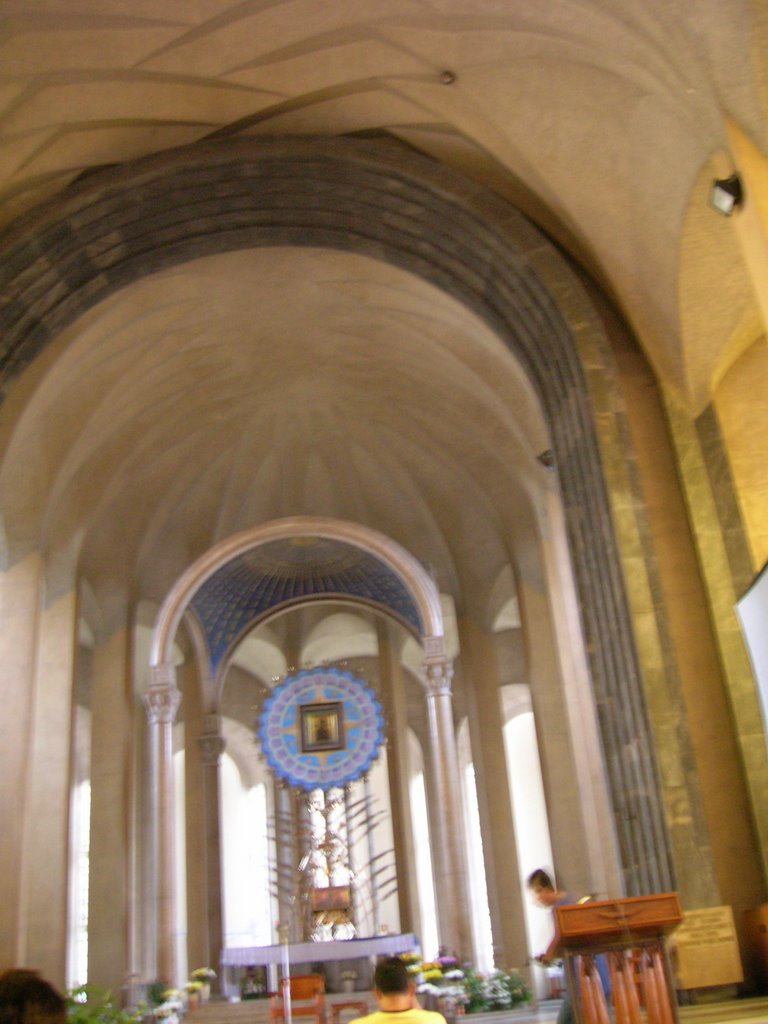

 Saturday, October 7, 2006 was the last of five consecutive First Saturday. Observed and meditated at Baclaran Church, Paranaque, MManila. Blessed Mother made sure I made it to the Philippines. It's significance, I know not at this time. I love you, LORD.
Sunday, October 15, 2006
Italian Catholics conference of interest to me...
A Church of the People or a Church of the Elite? Verona’s Dilemma
The transmission of the faith and attention to its “quality” are at the center of a major conference of Italian Catholics. The key point will be an address from the pope. The controversy over “Christian distinctiveness”
by Sandro Magister
Tuesday, October 10, 2006
Cardinal Sean of Boston archdiocese blogs!
A Capuchin Cardinal who blogs!!! Click here for his recent post, then read archives about his sojourn in Rome. Beautiful pictures of a Vatican insider.
Brought many memories, queries and thoughts about Catholic Church - Pope Benedict, Capuchin friars, baptism, Bishop Sheen, Padre Pio and my faith journey.
Brought many memories, queries and thoughts about Catholic Church - Pope Benedict, Capuchin friars, baptism, Bishop Sheen, Padre Pio and my faith journey.
Saturday, September 30, 2006
Lord God, Pope & president of USA
Bible...
In the beginning, when God created the heavens and the earth, the earth was a formless wasteland, and darkness covered the abyss, while a mighty wind swept over the waters. Then God said, "Let there be light," and there was light. 4 God saw how good the light was. God then separated the light from the darkness. 5 God called the light "day," and the darkness he called "night." Thus evening came, and morning followed-the first day. Genesis 1:1-5Pope's Encyclicals...
ENCYCLICAL LETTERDEUS CARITAS EST OF THE SUPREME PONTIFF BENEDICT XVI TO THE BISHOPS, PRIESTS AND DEACONS, MEN AND WOMEN RELIGIOUS AND ALL THE LAY FAITHFUL ON CHRISTIAN LOVEDeclaration of Independence of United States of America.
INTRODUCTION
1. “God is love, and he who abides in love abides in God, and God abides in him” (1 Jn 4:16). These words from the First Letter of John express with remarkable clarity the heart of the Christian faith: the Christian image of God and the resulting image of mankind and its destiny. In the same verse, Saint John also offers a kind of summary of the Christian life: “We have come to know and to believe in the love God has for us”.
IN CONGRESS, July 4, 1776.
The unanimous Declaration of the thirteen united States of America,
When in the Course of human events, it becomes necessary for one people to dissolve the political bands which have connected them with another, and to assume among the powers of the earth, the separate and equal station to which the Laws of Nature and of Nature's God entitle them, a decent respect to the opinions of mankind requires that they should declare the causes which impel them to the separation.
We hold these truths to be self-evident, that all men are created equal, that they are endowed by their Creator with certain unalienable Rights, that among these are Life, Liberty and the pursuit of Happiness.--That to secure these rights, Governments are instituted among Men, deriving their just powers from the consent of the governed, --That whenever any Form of Government becomes destructive of these ends, it is the Right of the People to alter or to abolish it, and to institute new Government, laying its foundation on such principles and organizing its powers in such form, as to them shall seem most likely to effect their Safety and Happiness.
Prudence, indeed, will dictate that Governments long established should not be changed for light and transient causes; and accordingly all experience hath shewn, that mankind are more disposed to suffer, while evils are sufferable, than to right themselves by abolishing the forms to which they are accustomed.
Monday, September 25, 2006
Pope Benedict, Socrates & Reason
Socrates or Muhammad? Joseph Ratzinger on the destiny of reason. by Lee Harris
Socrates skillfully employed paradox as a way to get people to think, yet even he might have been puzzled by the paradox of a Roman Catholic pope who is asking for a return to Socratic doubt and self-critique. Benedict must be perfectly aware of this paradox himself, so that we must assume that he, too, is using paradox deliber ately, as Socrates did, and for the same reason: to startle his listeners into rethinking what they thought they already knew.
A culture of reason is one in which the ideal of the dialogue has become the foundation of the entire community. In a culture of reason, everyone has agreed to regard violence as an illegitimate method of changing other people's minds. The only legitimate method of effecting such change is to speak well and to reason properly. Furthermore, a culture of reason is one that privileges the spirit of Greek philosophic inquiry: It encourages men to think for themselves.
Socrates hated the very thought of slavery--slavery to other men, slavery to mere opinions, slavery to fear, slavery to our own low desires, slavery to our own high ambitions. He believed that reason could liberate human beings from these various forms of slavery. Socrates would have protested against the very thought of a God who was delighted by forced conversions, or who was pleased when his worshipers proudly boasted that they were his slaves. He would have fought against those who teach that the universe is an uncaring thing, or who tell us that freedom is an illusion and our mind a phantom. Ultimately, perhaps, Socrates would have seen little to distinguish between those who bow down trembling before an irrational god and those who resign themselves before an utterly indifferent universe.
In his moving and heroic speech, Joseph Ratzinger has chosen to play the part of Socrates, not giving us dogmatic answers, but stinging us with provocative questions. Shall we abandon the lofty and noble conception of reason for which Socrates gave his life? Shall we delude ourselves into thinking that the life of reason can survive without courage and character? Shall we be content with lives we refuse to examine, because such examination requires us to ask questions for which science can give no definite answer? The destiny of reason will be determined by how we in the modern West answer these questions.
Sunday, September 24, 2006
Causes of Division, The Letter of James
Where do the wars and where do the conflicts among you come from? Is it not from your passions that make war within your members? You covet but do not possess. You kill and envy but you cannot obtain; you fight and wage war. You do not possess because you do not ask. You ask but do not receive, because you ask wrongly, to spend it on your passions.
James 4:1-3
Monday, September 18, 2006
The Greatest Commandment
When the Pharisees heard that he had silenced the Sadducees, they gathered together, and one of them [a scholar of the law] tested him by asking, "Teacher, which commandment in the law is the greatest?"
He said to him, "You shall love the Lord, your God, with all your heart, with all your soul, and with all your mind. This is the greatest and the first commandment. The second is like it: You shall love your neighbor as yourself. The whole law and the prophets depend on these two commandments."
Matthew, 22:34-40
Sunday, September 17, 2006
Our Lady of Fatima protect Pope Benedict
our priest, nuns, men and women religious from this jihadists, Islamic fascists.
Saturday, September 16, 2006
Pope Benedict & Third Secret of Fatima, my interpretation
This is my personal interpretation of current events.
One of the Pope's title is Bishop of Rome.
Today's Bishop of Rome, Benedict XVl, is the 'Bishop dressed in White with other Bishops, Priests, men and women Religious going up a steep mountain'. The steep mountain is Western civilization who ignore, denies and nullify God with Islamic fascist as their soldiers who fires bullets and arrows at him and his men and women religious .
God give him strength and clarity of thought to remind civilization of the Creator's role.
Don't apologize, Pope Benedict! Truth is truth. A big cross awaits you at the top of the mountain which has two angels with aspersorium in each arm.
One of the Pope's title is Bishop of Rome.
Today's Bishop of Rome, Benedict XVl, is the 'Bishop dressed in White with other Bishops, Priests, men and women Religious going up a steep mountain'. The steep mountain is Western civilization who ignore, denies and nullify God with Islamic fascist as their soldiers who fires bullets and arrows at him and his men and women religious .
God give him strength and clarity of thought to remind civilization of the Creator's role.
Don't apologize, Pope Benedict! Truth is truth. A big cross awaits you at the top of the mountain which has two angels with aspersorium in each arm.
And we saw in an immense light that is God: ‘something similar to how people appear in a mirror when they pass in front of it' a Bishop dressed in White ‘we had the impression that it was the Holy Father'. Other Bishops, Priests, men and women Religious going up a steep mountain, at the top of which there was a big Cross of rough-hewn trunks as of a cork-tree with the bark; before reaching there the Holy Father passed through a big city half in ruins and half trembling with halting step, afflicted with pain and sorrow, he prayed for the souls of the corpses he met on his way; having reached the top of the mountain, on his knees at the foot of the big Cross he was killed by a group of soldiers who fired bullets and arrows at him, and in the same way there died one after another the other Bishops, Priests, men and women Religious, and various lay people of different ranks and positions. Beneath the two arms of the Cross there were two Angels each with a crystal aspersorium in his hand, in which they gathered up the blood of the Martyrs and with it sprinkled the souls that were making their way to God.
Friday, September 15, 2006
Pope Benedict XVl and Third Secret of Fatima
This is Pope Benedict's interpretation of the Third Secret revealed to the children of Fatima.
This is the Third Secret in Sister Lucia's words.
The concluding part of the “secret” uses images which Lucia may have seen in devotional books and which draw their inspiration from long-standing intuitions of faith. It is a consoling vision, which seeks to open a history of blood and tears to the healing power of God. Beneath the arms of the cross angels gather up the blood of the martyrs, and with it they give life to the souls making their way to God. Here, the blood of Christ and the blood of the martyrs are considered as one: the blood of the martyrs runs down from the arms of the cross. The martyrs die in communion with the Passion of Christ, and their death becomes one with his. For the sake of the body of Christ, they complete what is still lacking in his afflictions (cf. Col 1:24). Their life has itself become a Eucharist, part of the mystery of the grain of wheat which in dying yields abundant fruit. The blood of the martyrs is the seed of Christians, said Tertullian. As from Christ's death, from his wounded side, the Church was born, so the death of the witnesses is fruitful for the future life of the Church. Therefore, the vision of the third part of the “secret”, so distressing at first, concludes with an image of hope: no suffering is in vain, and it is a suffering Church, a Church of martyrs, which becomes a sign-post for man in his search for God. The loving arms of God welcome not only those who suffer like Lazarus, who found great solace there and mysteriously represents Christ, who wished to become for us the poor Lazarus. There is something more: from the suffering of the witnesses there comes a purifying and renewing power, because their suffering is the actualization of the suffering of Christ himself and a communication in the here and now of its saving effect. And so we come to the final question: What is the meaning of the “secret” of Fatima as a whole (in its three parts)? What does it say to us? First of all we must affirm with Cardinal Sodano: “... the events to which the third part of the ‘secret' of Fatima refers now seem part of the past”. Insofar as individual events are described, they belong to the past. Those who expected exciting apocalyptic revelations about the end of the world or the future course of history are bound to be disappointed. Fatima does not satisfy our curiosity in this way, just as Christian faith in general cannot be reduced to an object of mere curiosity. What remains was already evident when we began our reflections on the text of the “secret”: the exhortation to prayer as the path of “salvation for souls” and, likewise, the summons to penance and conversion. I would like finally to mention another key expression of the “secret” which has become justly famous: “my Immaculate Heart will triumph”. What does this mean? The Heart open to God, purified by contemplation of God, is stronger than guns and weapons of every kind. The fiat of Mary, the word of her heart, has changed the history of the world, because it brought the Saviour into the world—because, thanks to her Yes, God could become man in our world and remains so for all time. The Evil One has power in this world, as we see and experience continually; he has power because our freedom continually lets itself be led away from God. But since God himself took a human heart and has thus steered human freedom towards what is good, the freedom to choose evil no longer has the last word. From that time forth, the word that prevails is this: “In the world you will have tribulation, but take heart; I have overcome the world” (Jn 16:33).
The message of Fatima invites us to trust in this promise.
JosephCard. Ratzinger, Prefect of the Congregation for the Doctrine of the Faith
This is the Third Secret in Sister Lucia's words.
J.M.J.
The third part of the secret revealed at the Cova da
Iria-Fatima, on 13 July 1917.
I write in obedience to you, my God, who command me to do so through his Excellency the Bishop of Leiria and through your Most Holy Mother and mine.
After the two parts which I have already explained, at the left of Our Lady and a little above, we saw an Angel with a flaming sword in his left hand; flashing, it gave out flames that looked as though they would set the world on fire; but they died out in contact with the splendour that Our Lady radiated towards him from her right hand: pointing to the earth with his right hand, the Angel cried out in a loud voice: ‘Penance, Penance, Penance!'. And we saw in an immense light that is God: ‘something similar to how people appear in a mirror when they pass in front of it' a Bishop dressed in White ‘we had the impression that it was the Holy Father'. Other Bishops, Priests, men and women Religious going up a steep mountain, at the top of which there was a big Cross of rough-hewn trunks as of a cork-tree with the bark; before reaching there the Holy Father passed through a big city half in ruins and half trembling with halting step, afflicted with pain and sorrow, he prayed for the souls of the corpses he met on his way; having reached the top of the mountain, on his knees at the foot of the big Cross he was killed by a group of soldiers who fired bullets and arrows at him, and in the same way there died one after another the other Bishops, Priests, men and women Religious, and various lay people of different ranks and positions. Beneath the two arms of the Cross there were two Angels each with a crystal aspersorium in his hand, in which they gathered up the blood of the Martyrs and with it sprinkled the souls that were making their way to God.
Tuy-3-1-1944”.
Pope Benedict & Muslims
Hold steadfast, stand firm and we pray for your strength, Pope Benedict.
Read the whole speech at this site and reason why Muslims are unreasonable in their attack on the Pope Benedict's speech.
How thin skin are they? Pope Benedict XVl has nothing to apologize for in this speech! Geez...
Read the whole speech at this site and reason why Muslims are unreasonable in their attack on the Pope Benedict's speech.
How thin skin are they? Pope Benedict XVl has nothing to apologize for in this speech! Geez...
I was reminded of all this recently, when I read the edition by Professor Theodore Khoury (Münster) of part of the dialogue carried on - perhaps in 1391 in the winter barracks near Ankara - by the erudite Byzantine emperor Manuel II Paleologus and an educated Persian on the subject of Christianity and Islam, and the truth of both. It was presumably the emperor himself who set down this dialogue, during the siege of Constantinople between 1394 and 1402; and this would explain why his arguments are given in greater detail than those of his Persian interlocutor. The dialogue ranges widely over the structures of faith contained in the Bible and in the Qur'an, and deals especially with the image of God and of man, while necessarily returning repeatedly to the relationship between - as they were called - three "Laws" or "rules of life": the Old Testament, the New Testament and the Qur'an. It is not my intention to discuss this question in the present lecture; here I would like to discuss only one point - itself rather marginal to the dialogue as a whole - which, in the context of the issue of "faith and reason", I found interesting and which can serve as the starting-point for my reflections on this issue.
In the seventh conversation (*4V8,>4H - controversy) edited by Professor Khoury, the emperor touches on the theme of the holy war. The emperor must have known that surah 2, 256 reads: "There is no compulsion in religion". According to the experts, this is one of the suras of the early period, when Mohammed was still powerless and under threat. But naturally the emperor also knew the instructions, developed later and recorded in the Qur'an, concerning holy war. Without descending to details, such as the difference in treatment accorded to those who have the "Book" and the "infidels", he addresses his interlocutor with a startling brusqueness on the central question about the relationship between religion and violence in general, saying: "Show me just what Mohammed brought that was new, and there you will find things only evil and inhuman, such as his command to spread by the sword the faith he preached". The emperor, after having expressed himself so forcefully, goes on to explain in detail the reasons why spreading the faith through violence is something unreasonable. Violence is incompatible with the nature of God and the nature of the soul. "God", he says, "is not pleased by blood - and not acting reasonably (F×<>The intention here is not one of retrenchment or negative criticism, but of broadening our concept of reason and its application. While we rejoice in the new possibilities open to humanity, we also see the dangers arising from these possibilities and we must ask ourselves how we can overcome them. We will succeed in doing so only if reason and faith come together in a new way, if we overcome the self-imposed limitation of reason to the empirically verifiable, and if we once more disclose its vast horizons. In this sense theology rightly belongs in the university and within the wide-ranging dialogue of sciences, not merely as a historical discipline and one of the human sciences, but precisely as theology, as inquiry into the rationality of faith. Only thus do we become capable of that genuine dialogue of cultures and religions so urgently needed today. In the Western world it is widely held that only positivistic reason and the forms of philosophy based on it are universally valid. Yet the world's profoundly religious cultures see this exclusion of the divine from the universality of reason as an attack on their most profound convictions. A reason which is deaf to the divine and which relegates religion into the realm of subcultures is incapable of entering into the dialogue of cultures. At the same time, as I have attempted to show, modern scientific reason with its intrinsically Platonic element bears within itself a question which points beyond itself and beyond the possibilities of its methodology. Modern scientific reason quite simply has to accept the rational structure of matter and the correspondence between our spirit and the prevailing rational structures of nature as a given, on which its methodology has to be based. Yet the question why this has to be so is a real question, and one which has to be remanded by the natural sciences to other modes and planes of thought - to philosophy and theology. For philosophy and, albeit in a different way, for theology, listening to the great experiences and insights of the religious traditions of humanity, and those of the Christian faith in particular, is a source of knowledge, and to ignore it would be an unacceptable restriction of our listening and responding. Here I am reminded of something Socrates said to Phaedo. In their earlier conversations, many false philosophical opinions had been raised, and so Socrates says: "It would be easily understandable if someone became so annoyed at all these false notions that for the rest of his life he despised and mocked all talk about being - but in this way he would be deprived of the truth of existence and would suffer a great loss". The West has long been endangered by this aversion to the questions which underlie its rationality, and can only suffer great harm thereby. The courage to engage the whole breadth of reason, and not the denial of its grandeur - this is the programme with which a theology grounded in Biblical faith enters into the debates of our time. "Not to act reasonably, not to act with logos, is contrary to the nature of God", said Manuel II, according to his Christian understanding of God, in response to his Persian interlocutor. It is to this great logos, to this breadth of reason, that we invite our partners in the dialogue of cultures. To rediscover it constantly is the great task of the university.
(emphasis mine)
Monday, September 11, 2006
Genesis 1, 1-13
In the beginning, when God created the heavens and the earth, the earth was a formless wasteland, and darkness covered the abyss, while a mighty wind swept over the waters. Then God said, "Let there be light," and there was light. God saw how good the light was. God then separated the light from the darkness. God called the light "day," and the darkness he called "night." Thus evening came, and morning followed--the first day.
Then God said, "Let there be a dome in the middle of the waters, to separate one body of water from the other." And so it happened: God made the dome, and it separated the water above the dome from the water below it. God called the dome "the sky." Evening came, and morning followed--the second day.
Then God said, "Let the water under the sky be gathered into a single basin, so that the dry land may appear." And so it happened: the water under the sky was gathered into its basin, and the dry land appeared. God called the dry land "the earth," and the basin of the water he called "the sea." God saw how good it was. Then God said, "Let the earth bring forth vegetation: every kind of plant that bears seed and every kind of fruit tree on earth that bears fruit with its seed in it." And so it happened: the earth brought forth every kind of plant that bears seed and every kind of fruit tree on earth that bears fruit with its seed in it. God saw how good it was. Evening came, and morning followed--the third day.
my thoughts... God created Light, Water and Vegetation on the first 3 days...
Sunday, September 10, 2006
Scripture reading for the day
6 Have no anxiety at all, but in everything, by prayer and petition, with thanksgiving, make your requests known to God. 7Then the peace of God that surpasses all understanding will guard your hearts and minds in Christ Jesus.
8 Finally, brothers, whatever is true, whatever is honorable, whatever is just, whatever is pure, whatever is lovely, whatever is gracious, if there is any excellence and if there is anything worthy of praise, think about these things. 9 Keep on doing what you have learned and received and heard and seen in me. Then the God of peace will be with you.
Philippians, 4, 6-9 (NAB)
Philippians, 4, 6-9 (NAB)
Saturday, September 02, 2006
First Saturday Devotion to Our Lady
Five Consecutive First Saturday Devotion to our Blessed Mother
1. Communion
2. Rosary
3. Meditate for 15 minutes the mysteries of the rosary
4. Confession
Saturday, September 2, 2006 (4th) fulfilled at Christ the King Catholic Church, Las Vegas Nevada.
atr and I are in Las Vegas for his sister, Carmen's birthday and big house blessing today.
Bible Readings for today here.
Consider your own calling, brothers and sisters. Not many of you were wise by human standards, not many were powerful, not many were of noble birth. Rather, God chose the foolish of the world to shame the wise, and God chose the weak of the world to shame the strong, and God chose the lowly and despised of the world, those who count for nothing, to reduce to nothing those who are something, so that no human being might boast before God. It is due to him that you are in Christ Jesus, who became for us wisdom from God, as well as righteousness, sanctification, and redemption, so that, as it is written, Whoever boasts, should boast in the Lord.Blessed the nation whose God is the LORD, the people he has chosen for his own inheritance. From heaven the LORD looks down; he sees all mankind.Blessed the people the Lord has chosen to be his own.GospelJesus told his disciples this parable:“A man going on a journey called in his servants and entrusted his possessions to them. To one he gave five talents; to another, two; to a third, one– to each according to his ability. Then he went away. Immediately the one who received five talents went and traded with them, and made another five. Likewise, the one who received two made another two. But the man who received one went off and dug a hole in the groundand buried his master’s money. After a long time the master of those servants came back and settled accounts with them. The one who had received five talentscame forward bringing the additional five. He said, ‘Master, you gave me five talents. See, I have made five more.’ His master said to him, ‘Well done, my good and faithful servant. Since you were faithful in small matters, I will give you great responsibilities. Come, share your master’s joy.’ Then the one who had received two talents also came forward and said, ‘Master, you gave me two talents. See, I have made two more.’ His master said to him, ‘Well done, my good and faithful servant. Since you were faithful in small matters, I will give you great responsibilities. Come, share your master’s joy.’ Then the one who had received the one talent came forward and said, ‘Master, I knew you were a demanding person, harvesting where you did not plant and gathering where you did not scatter; so out of fear I went off and buried your talent in the ground. Here it is back.’ His master said to him in reply, ‘You wicked, lazy servant! So you knew that I harvest where I did not plantand gather where I did not scatter? Should you not then have put my money in the bank so that I could have got it back with interest on my return? Now then! Take the talent from him and give it to the one with ten. For to everyone who has, more will be given and he will grow rich; but from the one who has not, even what he has will be taken away. And throw this useless servant into the darkness outside, where there will be wailing and grinding of teeth.’”
Sunday, August 27, 2006
Thursday, August 17, 2006

Monday, August 07, 2006


Sunday, August 06, 2006

Clouds of Heaven

taken by my apo inside Air Portugal on the flight from Newark to Lisbon, Portugal, July 11, 2006
Subscribe to:
Posts (Atom)